Facility Piping Systems Handbook, Second Edition
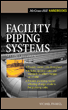
Using a total systems approach, this handbook progresses from fundamentals of system and component operation to a design procedure that allows quick and accurate component and pipe sizing.
 TABLE OF CONTENTS
 This chapter will describe various pressurized and gravity flow utility and service systems that are found outside of buildings on the site. These also include services that extend from buildings to points of connection or disposal. A common connection point for site work is considered to be 5 ft from the building wall.
Site utilities discussed here include subsurface drainage, storm water drainage and retention methods, sanitary drainage, water supply, and industrial and laboratory site drainage systems. Also included are sections that provide information and fundamentals of hydrology and design of buried piping.
Because of the close relationship of geology and hydrology to site utility work, it is useful to have an elementary knowledge of the hydrological cycle and underlying geological formations.
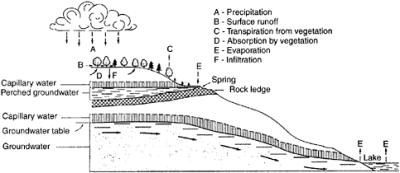
The continuous circulation of water through surface water, the atmosphere, and the land is called the hydrologic cycle. Inflow to the hydrologic system arrives as precipitation (rain or snowmelt) on the surface. Three things may then happen to this water. It may be pulled into the soil surface by capillary action and evaporated back into the atmosphere, be absorbed by plant roots and evaporated back into the atmosphere by transpiration through leaves and roots, or infiltrate down through the soil until it reaches the groundwater table. The hydrologic cycle is schematically illustrated in Fig. 6.1.
From surface sources, including rainfall, streams, rivers, and lakes, water...