Facility Piping Systems Handbook, Second Edition
Using a total systems approach, this handbook progresses from fundamentals of system and component operation to a design procedure that allows quick and accurate component and pipe sizing.
 TABLE OF CONTENTS
 Cryogenic gas, as used in this handbook, is defined as any gas in a liquid state at or below ?20 F. This chapter describes the bulk storage of cryogenic liquids used for laboratory and light industrial purposes and the piping of cryogenic liquids from storage tanks. There are two applications of cryogenic storage. The first is for a facility that uses a large volume of gas and needs storage on site for practical and economical reasons. The second is for cold liquids required for research, cooling, and other purposes.
Cryogenic storage systems for gases in health care facilities and distribution of gases created from cryogenic storage are discussed in Chap. 14, Compressed Gas Systems.
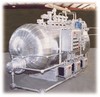
The major components of a cryogenic storage system include the bulk storage tank containing gas in liquid form, a vaporizer (if a gas is desired), and the piping network conveying either gas or liquid to the point of use. The vaporizer is directly connected to the storage tank and is used to convert the liquid gas into its gaseous state (see Fig. 8.1).

The following are codes used for the design and fabrication of cryogenic systems:
Underwriters Laboratories, UL-644
ASME Code for Unfired Pressure Vessels
NFPA 50, 50A, and SOB
NFPA 99 Health Care Facilities (often used as a standard for laboratory piping)
ASTM G-88
ASME/ASTM B3 1.3 Code for Pressure Piping
Gas is often stored as a cryogenic liquid when the...