Facility Piping Systems Handbook, Second Edition
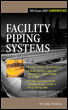
Using a total systems approach, this handbook progresses from fundamentals of system and component operation to a design procedure that allows quick and accurate component and pipe sizing.
 TABLE OF CONTENTS
 This chapter describes criteria, production, and the piping distribution network for various vacuum air systems. Because of the diverse uses and different design criteria for each, this chapter is divided into the following separate sections; health care facilities, laboratory systems, industrial applications, and central vacuum cleaning systems.
The performance of any vacuum air system is based on two factors: the flow volume measured in cfm (Lpm) and the maximum vacuum maintained in the system. For most vacuum systems to function, air becomes the transporting medium for any gas or suspended solids, and the pressure provides the energy for transportation. These two essential factors operate in inverse proportion as the airflow increases, the vacuum pressure decreases. The various systems must be designed to produce specific vacuum pressure and airflow levels that have been determined, often by experience and experimentation, to be most effective in performing their respective tasks. The exception is where vacuum pressure is intended to produce a force used to lift objects or simply to evacuate an enclosed space. For these uses, airflow is only a function of how long it takes the system to achieve its ultimate vacuum pressure.
Vacuum is defined as an air pressure less than atmospheric. The vacuum level is the difference in pressure between the evacuated system and the atmosphere. Vacuum pressures generally used in the United States fall into three broad categories:
Rough (or coarse) vacuum, up to 28 inHg
Medium (or fine) vacuum,...