Handbook of Electric Power Calculations, Third Edition
A powerful calculations tool for electric power engineers and technicians, this book offers essential, step-by-step procedures and examples for solving a wide array of electric power problems.
 TABLE OF CONTENTS
 A.Wayne Galli, Ph.D.
Project Engineer
Newport News Shipbuilding
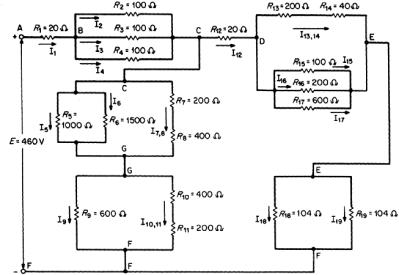
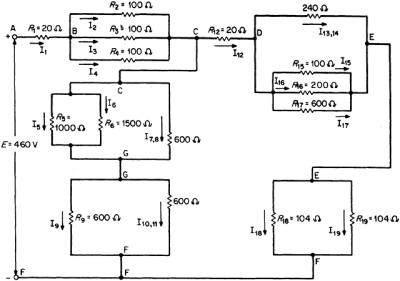
A direct-current circuit (network) contains 19 resistors arranged as shown in Fig. 1.1. Compute the current through and the voltage drop across each resistor in this circuit.

1 . Label the Circuit
Label all the sections. Mark the direction of current through each resistor (Fig. 1.2). The equivalent resistance of the series-parallel combination of resistors can be found by successive applications of the rules for combining series resistors and parallel resistors.
2. Combine All Series Resistors
In a series circuit, the total or equivalent resistance R EQS seen by the source is equal to the sum of the values of the individual resistors: R EQS= R 1+ R 2+ R 3+ + R N .
Calculate the series equivalent of the elements connected in series in sections DE, CG, and GF: R EQS (section DE)= R 13+ R 14=200+40=240 ?, R EQS (section CG)= R 7+ R 8=200+400=600 ?, and R EQS (section GF)= R 10+ R 11=400+200= 600 ?. Replace the series elements included in sections DE, CG, and GF by their equivalent values (Fig. 1.3).
3. Combine All Parallel Resistors
In...