Handbook of Electric Power Calculations, Third Edition
A powerful calculations tool for electric power engineers and technicians, this book offers essential, step-by-step procedures and examples for solving a wide array of electric power problems.
 TABLE OF CONTENTS
 Hashem Oraee
Worcester Polytechnic Institute
The induction motor is the most rugged and widely used machine in industry. Both stator winding and rotor winding carry alternating current. The alternating current is supplied to the stator winding directly and to the rotor winding by induction hence the name induction machine.
The induction machine can operate both as a motor and as a generator. However, it is seldom used as a generator. The performance characteristics as a generator are not satisfactory for most applications.
The three-phase induction motor is used in various sizes. Large motors are used in pumps, fans, compressors, and paper mills.
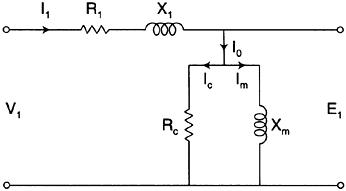
The stator winding can be represented as shown in Fig. 5.1. Note that there is no difference in form between the stator equivalent circuit and that of the transformer primary winding. The only difference lies in the magnitude of the parameters. For example, the excitation  is considerably larger in the induction motor because of the air gap. The rotor winding can be represented as shown in Fig. 5.2.
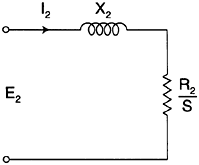
The equivalent circuit of the induction motor is obtained by combining the stator and rotor equivalent circuit (Fig. 5.3). Note that the form of the equivalent circuit is identical to that of a two-winding transformer.
A three-phase, 15-hp, 460-V, four-pole, 60-Hz, 1710-r/min induction motor delivers full output power to the load connected to its shaft. The friction and windage loss of the motor is...