Handbook of Electric Power Calculations, Third Edition
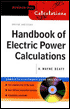
A powerful calculations tool for electric power engineers and technicians, this book offers essential, step-by-step procedures and examples for solving a wide array of electric power problems.
 TABLE OF CONTENTS
 Yilu (Ellen) Liu
Associate Professor
Electrical Engineering Department
Virginia Tech University
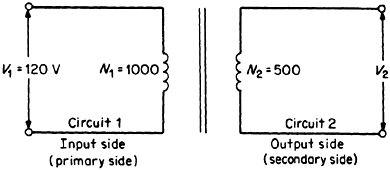
Compute the value of the secondary voltage, the voltage per turn of the primary, and the voltage per turn of the secondary of the ideal single-phase transformer of Fig. 4.1.
1. Compute the Value of the Secondary Voltage
The turns ratio, a, of a transformer is the ratio of the primary turns, N 1, to the sec- to the secondary turns, N 2 , or the ratio of the primary voltage, V 1, to the secondary voltage, V 2; a= N 1/ N 2= V 1/ V 2 . Substitution of the values indicated in Fig. 4.1 for the turns ratio yields a=1000/500=2. Secondary voltage V 2= V 1/ a=120/2=60V.
2. Compute the Voltage per Turn of the Primary and Secondary Windings
Voltage per turn of the primary winding= V 1/ N 1=120/1000=0.12 V/turn. Voltage per turn of the secondary winding = V 2/ N 2=60/500=0.12V/turn.
Related Calculations. This procedure illustrates a step-down transformer. A characteristic of both step-down and step-up transformers is that the voltage per turn of the primary is equal to the voltage per turn of the secondary.
Calculate the turns ratio of the transformer in Fig. 4.1 when it is employed as a step-up transformer.