Industrial Chemical Process Design
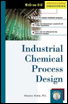
Including complex operations and formulas that are explained in an easy-to-understand format, this book provides the solutions to some of the most complex problems in chemical process design.
 TABLE OF CONTENTS
 Of all the many and varied aspects of the chemistry of metals, the industrial importance of iron and the various products derived from it are traditionally singled out for special emphasis. It is certainly true that the many rich deposits of high-grade iron ores, the relative ease and low cost with which the metal may be extracted, and its many useful properties have made iron the cornerstone of industrial development. Although modern trends in the metallurgical industries indicate rather clearly that certain of the light metals may eventually come to rival the dominant position of iron, many years will elapse before it is relegated to a position of secondary importance.
Iron occurs in a wide variety of chemical combinations in nature. Of these, oxides, sulfides, and carbonates are the compounds used as commercial sources of iron. Hematite (Fe 2O 3) is by far the most important. Other iron ores used to a lesser extent include limonite [(Fe 2O 3) 2 3H 2O], magnetite or magnetic oxide of iron (Fe 3O 4), siderite (FeCO 3), and pyrite (FeS 2).
Most of the countries having any marked degree of industrial development have readily available deposits of iron ores. In the United States, the Lake Superior region (Minnesota, Michigan, and Wisconsin) furnishes about 65% of the domestic production while the remainder is obtained from ores located in Alabama, New York, Colorado, California, Virginia,...