Industrial Chemical Process Design

Including complex operations and formulas that are explained in an easy-to-understand format, this book provides the solutions to some of the most complex problems in chemical process design.
 TABLE OF CONTENTS
 Raoult s law is a generalized statement that the equilibrium vapor pressure which is exerted by a component in a solution is proportional to the mole fraction of that component in the solution [1]. The term solution here designates a liquid phase having two or more components which each exert vapor pressure. Thus the following equation may be established:

where<i class="emphasis">n</i><sub<i class="emphasis">a</i></sub><i class="emphasis">,n</i><sub<i class="emphasis">b</i></sub><i class="emphasis">,n</i><sub<i class="emphasis">c</i></sub> = moles of components <i class="emphasis">a, b, c,</i> <i class="emphasis">N</i><sub<i class="emphasis">a </i></sub>= mole fraction of component a in liquid solution<i class="emphasis">p</i><sub<i class="emphasis">a </i></sub>= vapor pressure of component <i class="emphasis">a</i> in solution with components <i class="emphasis">b, c,</i> <i class="emphasis">P</i><sub<i class="emphasis">a </i></sub>= vapor pressure of component <i class="emphasis">a</i> in pure state (<i class="emphasis">Lange s</i><i class="emphasis"> Handbook of Chemistry</i> [<a class="chapterjump"> href="portalcontent.asp?bkid=15207&destid=1819#1819"> target="_parent">2</a>] or other data sources)
Having now established a methodology to find the solute a vapor pressure in both the feed phase and the solvent phase of liquid-liquid extraction, the Henry s law constants H f and H s may be calculated independently by the following equations:
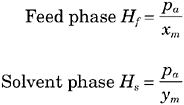
where <i class="emphasis">x</i><sub<i class="emphasis">m </i></sub>= mole fraction of component <i class="emphasis">a</i> (the solute) in the feed<i class="emphasis">y</i><sub<i class="emphasis">m </i></sub>= mole fraction of component <i class="emphasis">a</i> (the solute) in the solvent
Vapor pressure calculations for component a are to be made independently. More simply, calculate the feed vapor pressure a disregarding any effect of partial pressures exerted by the solvent phase. The same holds true for the solvent phase. If the...