Introduction to Communication Systems Simulation
Chapter 2: Linear Time Invariant Systems

Linear time invariant (LTI) systems are the backbone of much of the analysis of communication systems, especially filtering operations. In this chapter we develop the concept of an LTI filter in the time domain. This immediately leads to the Fourier transform (FT). Starting with the continuous FT, we continue to the digital Fourier transform (DFT), which is used on a computer. The concept of FT windows is introduced here. Finally, we describe the all-important fast Fourier transform (FFT) algorithm via a specific example.

2.1 LTI Systems

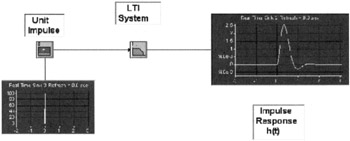
Consider a system described by a time function h (t). We observe h(t) by kicking it with a unit impulse response ?(t), as shown in Figure 2.1. The function h(t) is then called the unit impulse response of the system. A system is said to be time invariant if the impulse is delayed by T, and the output is delayed by the same amount h(t ? T); that is, the system does not change in time. A time variant system could occur if someone changed the value of some element of your system, such as a resistor or capacitor. In fact, there are capacitors called varactors that can be controlled by an input voltage, which could be any function of time.


Figure 2.1: Linear system impulse response.

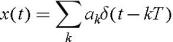
Now let the input signal be a series of impulses, a k , separated by time T. Then the input can be written as


Then the output becomes

UNLIMITED FREE
ACCESS
TO THE WORLD'S BEST IDEAS

SUBMIT
Already a GlobalSpec user? Log in.

This is embarrasing...

An error occurred while processing the form. Please try again in a few minutes.

Customize Your GlobalSpec Experience

Category: Data Acquisition Systems and Instruments
Finish!
Privacy Policy

This is embarrasing...

An error occurred while processing the form. Please try again in a few minutes.