Introduction to Communication Systems Simulation
In this chapter we take up how to implement filters in a simulation. We start out by developing the theories of the continuous Laplace or s transform, and its digital equivalent, the z transform. Then we develop the concepts for finite impulse response (FIR) filters and infinite impulse response (IIR) filters. Next we detail how one transforms from the s to z domain. Finally we take up some practical issues about running IIR filters in the z domain.
For a filter with a complex frequency domain transfer function H (f), we can write it in the following useful form:
A(f) is called the amplitude response, and ?(f) is called the phase response. Both of these functions are real valued. In Chapter 2 we noted that for a real-time function, the FT must have the symmetry
This in turn implies that A( ? f)= A(f) , and ?( ? f) = ? ?(f).
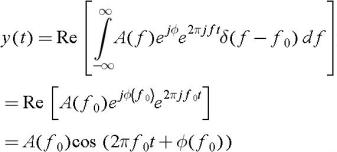
Now consider the response of such a filter to a pure cosine wave input frequency f 0. From basic FT, the output time response of the filter y(t) is
The result emphasized the meaning of the gain, and phase (delay) of a filter. Now consider a somewhat more complicated case where the input x(t) is two cosine waves with slightly different frequencies f0 ? f.
The result is a low frequency AM modulation of the carrier frequency f 0 by...