Introduction to Communication Systems Simulation
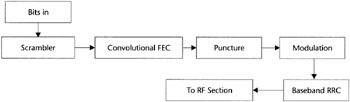
The DS-UWB system is much like the DS spread spectrum concept discussed in Chapter 6. The data bits are replaced by code words, as shown in Section 13.1.5. Figure 13.2 is the general block diagram of the system. The remaining sections provide the pertinent details.
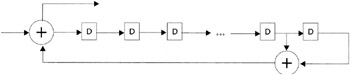
Most wireless systems use a scrambler. Note that this is not the same as an interleaver. The idea of the scrambler is to preclude transmitting long strings of [1] or [0] bits. Figure 13.3 shows this operation. The feedback system is just as described in Chapter 6 regarding DSSS systems. The polynomial in this case is
The only difference here is that the input data [b] is running at the same rate as the shift back register. In other words, there is no expansion of bandwidth here. The output of the scrambler is given by
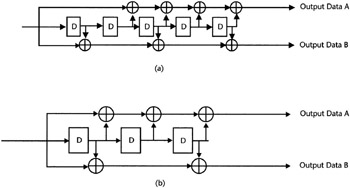
The DS-UWB employs two different convolutional codes as shown in Figure 13.4(a, b).
Both of the encoders are rate 1/2. This means that there are two output bits for every one input bit, which doubles the required transmission bandwidth. In many cases this is unacceptable, and a lower rate such as 2/3 or 3/4 is desired. One way to do this is to directly...