Here is a common simulation scenario. Consider an IS-136 wireless system. The carrier frequency is in the 880-MHz range, while the symbol rate is 24.3 Ksps. To implement such a system, the sample rate must be at least four times the carrier frequency, or 3.52 Gsps. But this is a huge overkill with respect to the information rate. In this chapter we develop the concept of baseband simulation, which eliminates the carrier altogether. We sample at a rate that is commensurate with the information bandwidth, thus greatly reducing the simulation time. Note, however, that this tactic works only if there are no nonlinear elements in the system such as amplifiers with IP 3, or when evaluating the effects of a frequency fade channel. In those cases the results are dependant on the actual carrier frequency, and we are stuck with the complete sampling system.
12.1 Basic Concept
We start with any system where the information is in the baseband forms I(t) and Q(t). We modulate this signal on a carrier to obtain the transmitted signal
where ? represents an unknown phase of the received carrier with respect to the carrier used in the I/Q down conversion.
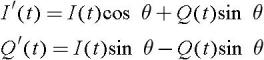
At the receiver, we down convert s(t) back to baseband using the quadrature technique as described in Chapter 6. After filtering out the 2f 0 term, we have the estimates of the symbols I(t) and Q(t)
The whole trick now is to represent I and Q
Copyright ARTECH HOUSE, INC. 2006 under license agreement with Books24x7

 TABLE OF CONTENTS