Introduction to Communication Systems Simulation
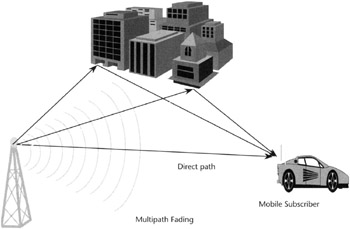
In Chapter 1 we defined the channel to be the media that the signal passes through from the transmit antenna to the receive antennas. One major component that describes the channel is the signal fading phenomena. As shown in Figure 10.1, the transmitted signal can bounce off objects, each reflecting energy to the receive antenna. The sum total of all of these reflections can cause the resulting signal to lose relative power by cancellation, either in total or at select frequencies. We now develop in more detail this concept and some methods of simulation.
Consider a transmitted signal of the form
Now suppose that this signal bounces off many object and reflects back to the receiver. Each path has a delay ?. The difference between the maximum and minimum delay is called the delay spread. The net received signal r(t) is
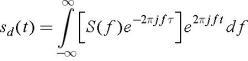
The concept of flat fading is based on the following observation. If a signal is simply passed through a delay line, then the output can be written as
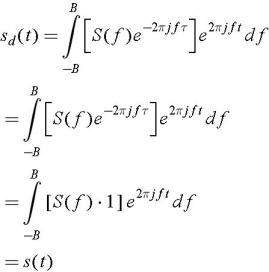
Now if the spectrum S(f) is confined to a bandwidth B<<1/ ?, the exponential term in the bracket is essentially constant over the active integration, giving
For all practical purposes, the delay does not affect the modulation component of the signal except for a possible gain factor ? k . With...