Introduction to Communication Systems Simulation
Chapter 13: Ultra-Wideband Systems

Overview

UWB systems are currently undergoing intense development by a large number of commercial organizations worldwide. The goal is to provide a very high data rate for applications in wireless communications. In this chapter we present the current state of development in the field. The system concepts are still under a state of flux and what finally emerges may differ from what is presented here. However, most of the basic concepts should not change.

The first observation is the nature of wireless use and capability. From Chapter 5 on detection theory we noted that the output SNR of the detection matched filter is


for a constant envelope signal of amplitude A, and data rate R. Clearly, as R increases, the SNR goes down for a fixed A. To make up for the loss, A must increase accordingly, but A 2 is the signal power that cannot be increased without limit. The bottom line is that the wireless UWB applications are intended for a very short range. The terminology is called wireless personal area networks (WPANs), which operate over distances of the order of room size.

What is a UWB system? The following is the current definition:

  • Bandwidth contained within 3.1 to 10.6 GHz (communication sys.);

  • Maximum EIRP of ?41.3 dBm/MHz;

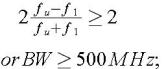
  • UWB BW defined by


  • No modulation scheme is implied.

Figure 13.1 shows the two-band allocation for UWB systems. The low band occupies 3.1 to 5.0 MHz, while the high...

UNLIMITED FREE
ACCESS
TO THE WORLD'S BEST IDEAS

SUBMIT
Already a GlobalSpec user? Log in.

This is embarrasing...

An error occurred while processing the form. Please try again in a few minutes.

Customize Your GlobalSpec Experience

Category: Chip Antennas
Finish!
Privacy Policy

This is embarrasing...

An error occurred while processing the form. Please try again in a few minutes.