Introduction to Communication Systems Simulation
Chapter 5: Digital Detection

In this chapter, we develop the basic concepts used in digital detection theory. We start with a concept called a vector channel and arrive at the concept of vector distances and decision boundaries. Following this, we extend the analysis to that of time domain signals. Several optimum receiver architectures are derived and outlined.

5.1 The Vector Channel

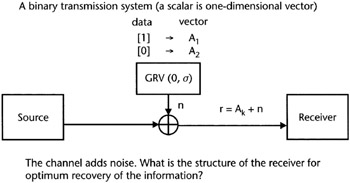
We start with the simplest example, shown in Figure 5.1. A logical [1] is encoded as a value A1, and a logical [0] as a value A2. Between the source and receiver, the channel is AWGN, which is modeled as a Gaussian random variable (GRV).


Figure 5.1: Basic binary vector channel detection diagram.

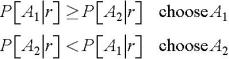
The detection rule is to choose between A 1 and A 2, according to the conditional probability that


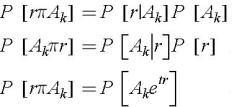
The standard trick is to employ Bayes theorem to invert the arguments of the conditional probability


We can now write


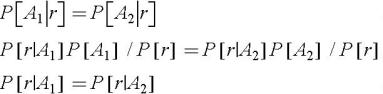
Finally, we find a boundary value r according to the rule


We have made the logical assumption that each message has equal probability of occurrence.

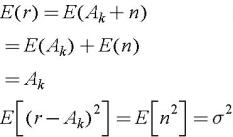
What have we gained by all of this manipulation? A lot, because we can write the expression for P[ r A k]. The received value r is the sum of the message and the GRV noise term. It then follows that r is a GRV as well. So the only thing we need to know is the mean and variance of r, specifically


Since the noise is...

UNLIMITED FREE
ACCESS
TO THE WORLD'S BEST IDEAS

SUBMIT
Already a GlobalSpec user? Log in.

This is embarrasing...

An error occurred while processing the form. Please try again in a few minutes.

Customize Your GlobalSpec Experience

Category: IC Electronic Filters
Finish!
Privacy Policy

This is embarrasing...

An error occurred while processing the form. Please try again in a few minutes.