LabVIEW Graphical Programming, Fourth Edition
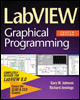
Written in a highly accessible and readable style, this book illustrates basic LabVIEW programming techniques as well as advanced programming concepts.
 TABLE OF CONTENTS
 Now we are ready to look at the nuts and bolts of LabVIEW programming, beginning with the fundamentals of how to control LabVIEW flow. A fundamental theme of LabVIEW programming is dataflow and executing nodes based on data dependency. A well-written LabVIEW program flows in a left-to-right and top-to-bottom order, but the execution order is always governed by dataflow. Without dataflow it is impossible to determine execution order. In fact, if you place independent items on the block diagram without any data dependency between them, they will multitask in parallel. Multitasking is a powerful concept made simple in LabVIEW. However, usually you need to order a program's execution random execution in a test and measurement system is not a good idea. Dataflow can be forced through sequence frames, or through a common thread flowing through all the block diagram items.
CLAD The simplest way to force the order of execution is to use a Sequence structure as in the upper example of Figure 3.1. Data from one frame is passed to succeeding frames through Sequence local variables, which you create through a pop-up menu on the border of the Sequence structure. In a sense, this method avoids the use of (and advantages of) dataflow programming. You should try to avoid the overuse of Sequence structures. LabVIEW has a great deal of inherent parallelism, where GET A and GET B could be processed simultaneously. Using a sequence guarantees the order of execution but prohibits parallel operations. For instance, asynchronous tasks...