LabVIEW Graphical Programming, Fourth Edition
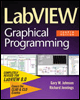
Written in a highly accessible and readable style, this book illustrates basic LabVIEW programming techniques as well as advanced programming concepts.
 TABLE OF CONTENTS
 LabVIEW has certainly made life easier for Gary, the engineer. I remember how much work it was in the early 1980s, writing hideously long programs to do what appeared to be simple measurement and control tasks. Scientists and engineers automated their operations only when it was absolutely necessary, and the casual users and operators wouldn't dare to tamper with the software because of its complexity. This computer-based instrumentation business was definitely more work than fun. But everything changed when, in mid-1987, I went to a National Instruments (NI) product demonstration. The company was showing off a new program that ran on a Macintosh. It was supposed to do something with instrumentation, and that sounded interesting. When I saw what those programmers had done and what LabVIEW could do I was stunned! Wiring up icons to write a program? Graphical controls? Amazing! I had to get hold of this thing and try it out for myself.
By the end of the year, I had taken the LabVIEW class and started on my first project, a simple data acquisition system. It was like watching the sun rise. There were so many possibilities now with this easy and fun-to-use programming language. I actually started looking for things to do with it around the lab (and believe me, I found them). It was such a complete turnaround from the old days. Within a year, LabVIEW became an indispensable tool for my work in instrumentation and control. Now my laboratories are not just computerized,