LabVIEW Graphical Programming, Fourth Edition
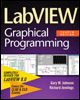
Written in a highly accessible and readable style, this book illustrates basic LabVIEW programming techniques as well as advanced programming concepts.
 TABLE OF CONTENTS
 We're going to bet that your first LabVIEW application was (or will be) some kind of data acquisition system. We say that because data acquisition is by far the most common LabVIEW application. Every experiment or process has signals to be measured, monitored, analyzed, and logged, and each signal has its own special requirements. Although it's impossible to design a universal data acquisition system to fit every situation, there are plenty of common architectures that you can use, each containing elements that you can incorporate into your own problem-solving toolkit.
As we mentioned in the Introduction, what you'll learn in this chapter are all the other things that the LabVIEW manuals and examples don't cover. The act of fetching data from an input device is the easy part, and it's a subject that is already well discussed. On the other hand, how do you keep track of channel assignments and other configuration information? And how does data analysis affect program design? These topics are important, yet rarely mentioned. It's time to change all that.
Your data acquisition application might include some control (output) functionality as well. Most experiments have some things that need to be manipulated some valves, a power supply set point, or maybe a motor. That should be no problem as long as you spend some time designing your program with the expectation that you will need some control features. If your situation requires a great deal of control functionality, read Chapter 18, "Process Control Applications," to...