LabVIEW Graphical Programming, Fourth Edition
Written in a highly accessible and readable style, this book illustrates basic LabVIEW programming techniques as well as advanced programming concepts.
 TABLE OF CONTENTS
 Adding smart controllers to your process control system is smart engineering. PLCs, SLCs, and other programmable devices are practical solutions to your real-world control problems. They are completely optimized to perform real-time continuous or sequential control with the utmost in reliability while managing to be flexible enough to adapt to many different situations. Take advantage of them whenever possible.
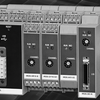
Programmable logic controllers (PLCs). A programmable logic controller (PLC) is an industrial computer with a CPU, nonvolatile program memory, and dedicated I/O interface hardware (Bryan and Bryan 1988). Conceived by General Motors Corporation in 1968 as a replacement for hardwired relay logic, PLCs have grown dramatically in their software and hardware capabilities and now offer incredible power and flexibility to the control engineer. Major features of a modern PLC are as follows:
Modular construction
Very high reliability (redundancy available for many models)
Versatile and robust I/O interface hardware
Wide range of control features included, such as logic, timing, and analog control algorithms
Fast, deterministic execution of programs a true real-time system
Communications supported with host computers and other PLCs
Many programming packages available
Low cost
You can buy PLCs with a wide range of I/O capacity, program storage capacity, and CPU speed to suit your particular project. The simplest PLCs, also called microcontrollers, replace a modest number of relays and timers, do only discrete (on/off, or boolean) logic operations, and support up to about 32 I/O points. Midrange PLCs add analog I/O and communications features and...