LabVIEW Graphical Programming, Fourth Edition
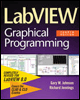
Written in a highly accessible and readable style, this book illustrates basic LabVIEW programming techniques as well as advanced programming concepts.
 TABLE OF CONTENTS
 To automate your lab, one of the first things you will have to tackle is data acquisition the process of making measurements of physical phenomena and storing them in some coherent fashion. It's a vast technical field with thousands of practitioners, most of whom are hackers as we are. How do most of us learn about data acquisition? By doing it, plain and simple. Having a formal background in engineering or some kind of science is awfully helpful, but schools rarely teach the practical aspects of sensors and signals and so on. It's most important that you get the big picture learn the pitfalls and common solutions to data acquisition problems and then try to see where your situation fits into the grand scheme.
This chapter should be of some help because the information presented here is hard-won, practical advice, for the most part. The most unusual feature of this chapter is that it contains no LabVIEW programming information. There is much more to a LabVIEW system than LabVIEW programming! If you plan to write applications that support any kind of input/output (I/O) interface hardware, read on.
Data acquisition deals with the elements shown in Figure 12.1. The physical phenomenon may be electrical, optical, mechanical, or something else that you need to measure. The sensor changes that phenomenon into a signal that is easier to transmit, record, and analyze usually a voltage or current. Signal conditioning amplifies and filters the raw signal to prepare it for analog-to-digital conversion (ADC), which...