Lineman's and Cableman's Handbook, Eleventh Edition

Filled with over 1500 illustrations, this classic text explains the basic principles, equipment, standards, and safety regulations required for optimal on-the-job performance.
 TABLE OF CONTENTS
 Unloading Wood Poles. Poles are shipped on railroad flatcars (Fig. 11.1) or flatbed semi-truck trailers. Great care must be exercised while unloading poles from the flatcar to avoid any possibility of an accident. Before starting the unloading operation, the railroad car brakes should be set to prevent the car from moving. The wheels should be chocked as an added precaution. Flags and barricades should be set up to safeguard the area. Mechanized equipment reduces the time required and the number of workers needed to unload the poles safely (Fig. 11.2).
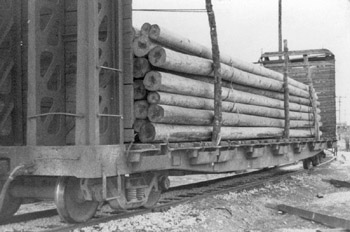
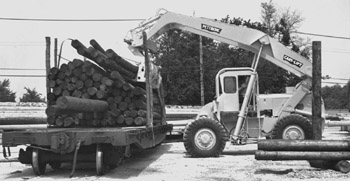
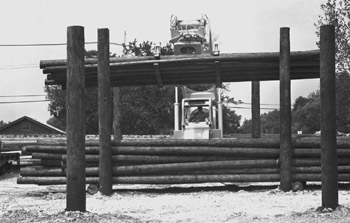
The lineman should inspect the stakes holding the poles to be sure the poles are secure before cutting the banding wires. The banding wires should be cut from the end of the poles cautiously by the lineman on the ground. After the banding wires are cut, equipment such as the Cary-Lift loader (Fig. 11.2) can be used to safely remove several poles at a time and place them on the pole storage pile (Fig. 11.3).
If mechanized equipment is not available, wood poles can be unloaded from a railroad flatcar with a winch line on...