Lineman's and Cableman's Handbook, Eleventh Edition

Filled with over 1500 illustrations, this classic text explains the basic principles, equipment, standards, and safety regulations required for optimal on-the-job performance.
 TABLE OF CONTENTS
 Electric transmission and distribution line installations have been designed to meet National Electrical Safety Code (NESC), ANSI C2, requirements and to provide the level of line outage performance required by system reliability criteria. Transmission and distribution lines are also designed to withstand the maximum overvoltages expected to be impressed on the system. Such overvoltages can be caused by such conditions as switching surges, faults, or lightning. Insulator design and lengths and the clearances to structural parts (which, for low voltage through extra-high voltage, or EHV, facilities, are generally based on the performance of the line as a result of contamination of the insulation or during storms) have, over the years, come closer to the minimum approach distances used by workers (which are generally based on nonstorm conditions). Thus, as minimum approach (working) distances and structural distances (clearances) converge, it is increasingly important that basic considerations for establishing safe approach distances for performing work be understood by the designers and the operating and maintenance personnel involved.
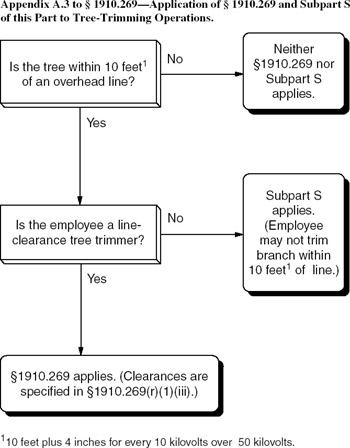
The information in this appendix will assist employers in complying with the minimum approach distance requirements contained in paragraphs (1)(2) and (q)(3) of this section. The technical criteria and methodology presented herein is mandatory for employers using reduced minimum approach distances as permitted in Table R.7 and Table R.8. This appendix is intended to provide essential background information and technical criteria for the development or modification, if possible, of the safe minimum approach distances...