Lineman's and Cableman's Handbook, Eleventh Edition

Filled with over 1500 illustrations, this classic text explains the basic principles, equipment, standards, and safety regulations required for optimal on-the-job performance.
 TABLE OF CONTENTS
 Distribution is that system component which delivers the energy from the generators, or the transmission system, to the customers. It includes the substations that reduce the high voltage of the transmission system to a level suitable for distribution and the circuits that radiate from the substation to the customers (Fig. 5.1).
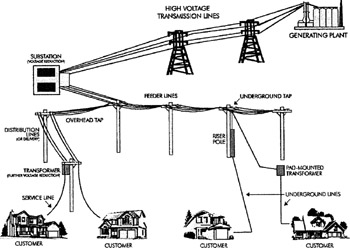
The distribution circuits that carry power from the substations to the local load areas are known as express feeders, distribution main feeders, or primary circuits and generally operate at voltages between 2400 and 34,500 volts. The loading of distribution circuits varies with customer load density, type of load supplied, and conditions peculiar to the area served. The nominal capacity of distribution circuits operating at different voltage levels is itemized in Table 5.1.
| Capacity, MVA | ||
|---|---|---|
| Voltage class, kV | Average | Maximum |
| 4-5 | 2.5 | 3.5 |
| 12-15 | 7.5 | 15.0 |
| 20-25 | 12.0 | 20.0 |
| 30-35 | 18.0 | 30.0 |
The distribution circuits may be overhead or underground depending on the load density and the physical conditions of the particular area to be served. The vast majority are constructed overhead on wood poles (Figs. 5.2 and 5.3) that may support communication facilities and street lights. Street lighting is an important part of the distribution system.