Lineman's and Cableman's Handbook, Eleventh Edition

Filled with over 1500 illustrations, this classic text explains the basic principles, equipment, standards, and safety regulations required for optimal on-the-job performance.
 TABLE OF CONTENTS
 Transmission- and distribution-line conductors must be joined together with full-tension splices if the conductors are under tension. Bolted connectors can be used to join electric conductors at locations where the conductors are slack, such as between conductor deadends. Figures 23.1 and 23.2 illustrate compression tools used for joining and dead-ending electric distribution conductors.
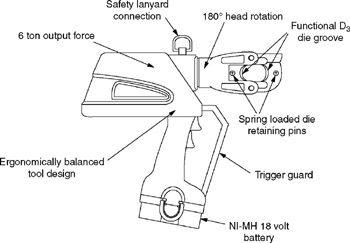
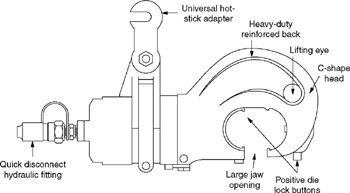
Compression-, internally fired-, implosive-, and automatic-type splices are used to obtain the strength and electrical conductivity needed to join together conductors in tension. The number of locations where the conductors are joined should be kept to a minimum. All splices in transmission-line conductors should be made at least 50 ft or more from the suspension or dead-end points. Splices should not be made in spans crossing over railroads, rivers, canals, or interstate highways. It is advisable to avoid splices in spans crossing over communications circuits or electric transmission and distribution lines, if possible.
The splices must be applied in accordance with the transmission-line specifications or distribution standards and in accordance with the splice manufacturer's instructions. The conductors of a transmission line requiring a full-tension splice should be laid out straight for a distance of 40 ft each way from the joining point and...