Modern Radar Systems, Second Edition

This chapter introduces a number of other ideas and conventions used in this book. Fuller explanations are given in the mathematics chapters. This is an introduction to the three-dimensional representation of complex values that vary with distance, time, or frequency. The types of diagrams described are:
Three-dimensional locus or working point diagrams;
Polyphase modulation, demodulation, and waveforms;
Symmetrical components;
Polyphase or bottlebrush noise;
Simultaneous representation of waveforms and spectra;
Gaussian pulses, spectra, and beam shapes.
These diagrams are chosen to communicate the shapes of the phenomena, to allow engineers to put figures on the shapes to allow calculation, and to apply them to radar. To start, the working point of a Wien bridge oscillator is described.
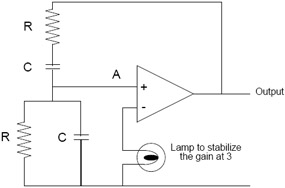
The Wien bridge oscillator in Figure 2.1 is well known.
The working point at the point A, referenced to zero by subtracting the network attenuation factor, is given by
| (2.1) | |
and the frequency of oscillation as
| (2.2) | |
In this example R is 1 000 ?, and C is 1 F, so that the oscillating frequency, f, is 159.1549 Hz.
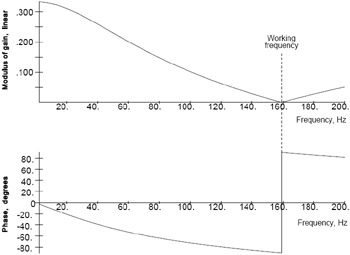
Traditionally Bode diagrams, showing the gain and phase shift around the loop at point A, are drawn as in Figure 2.2. The diagrams show discontinuities at the frequency of oscillation, which, by instinct, nature abhors.