Modern Radar Systems, Second Edition

Chapter 4: Microwave Waveguide and Transmission Line System

Overview

This chapter describes the components that connect the transmitters, antennas, and receivers together. During the Second World War (1939 1945), before technicians understood what was happening, they derogatorily used the word "plumbing" for this amazing assembly of magic pipes. These connecting elements absorb and reflect the energy in the transmitter pulses and the returning echoes. These losses are costly because radio frequency power lost in heat is the most expensive type of electrical power in the radar and especially critical in the parts of the system common to transmission and reception.

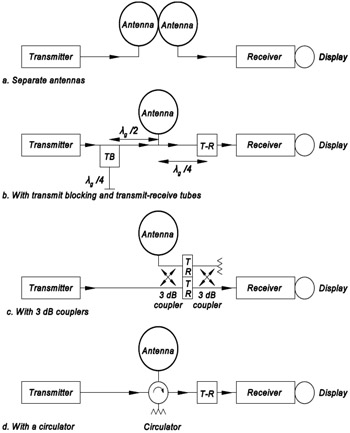
Historically, radars had to have two separate antennas in order to protect the receivers from the large transmitter power. This is shown in Figure 4.1(a). This is often the case with continuous wave radars.


Figure 4.1: The history of transmitter and receiver switching.

Later, during the Second World War, ways were found to connect microwave transmitters and receivers to a common antenna. A gas discharge tube was placed at the input to the receiver to protect it during the transmitter pulses. Originally, the magnetron transmitter reflected the received echo signals into the receiver. Later, transmitter blocking (TB) tubes were introduced to give better reflection. They were at the mouth of a quarter wavelength shorted stub (or open circuit at the mouth) and fired at the start of the transmitter pulse to allow it to pass, as in Figure 4.1(b). Tuned line lengths restrict the bandwidth, and an untuned switch may be made using two 3 dB couplers and two...

UNLIMITED FREE
ACCESS
TO THE WORLD'S BEST IDEAS

SUBMIT
Already a GlobalSpec user? Log in.

This is embarrasing...

An error occurred while processing the form. Please try again in a few minutes.

Customize Your GlobalSpec Experience

Category: Satellite Communications Equipment
Finish!
Privacy Policy

This is embarrasing...

An error occurred while processing the form. Please try again in a few minutes.