Modern Radar Systems, Second Edition

Radar is an acronym for radio detection and ranging. Once the echo signals have been detected, the position of the object that caused them must be estimated. The echo signals are combined with noise and the measurement accuracy depends on the signal-to-noise ratio. Traditionally, radars are divided into a number of types and examples of these types are:
Radars that turn their antennas towards the single "targets" that interest them, typically fire control radars and radars that track weather balloons or other single flying objects;
Radars that measure many target positions sequentially, typically modern fire control radars and artillery locating radars;
Radars that scan the volume around them continually, typically surveillance radars.
This chapter describes the measurement of position with a general discussion of accuracy.
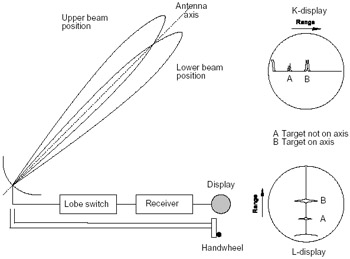
Fire control radars began to be developed before the start of the Second World War, to measure the positions of attacking aircraft, which were the targets for anti-aircraft artillery. First the antenna was moved by hand until the maximum signal was visible on an A-scope, which allowed the range of the target to be measured, but the angles were better measured by an optical director. Switching the antenna lobe to fixed positions on either side of the target direction allowed the two signals to be compared, as in Figure 13.1. When the two signals were equal, the antenna was pointing towards the target, which gave accurate angle measurements. Such radars required operators for azimuth, elevation, and range.