Modern Radar Systems, Second Edition

The input to the receiver consists of cosmic noise, which enters the antenna from outer space; echoes, which are returning copies of the transmitted pulse; and maybe interference from the sun (noise) or nearby unsuppressed electric devices. The returning copies of the transmitted pulse vary in amplitude, depending on the size and the range of the object causing the echo. The phases of the returning echoes depend on their range within domains of half a wavelength ( ?/2). The purpose of the receiver is to amplify the echo signals, filter out all other signals, and pass the echo signals to the matched filter section.
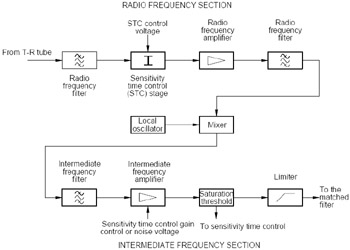
There are simple and more complex receivers, depending on the type and cost of the radar. Modern signal processors depend on their ability to find the correct difference of large numbers over a number of pulses, so more modern receivers have a wide dynamic range. Older receivers use limiting or logarithmic amplifiers to compress the dynamic range. The blocks described in this section are shown in Figure 7.1.
The number of receivers depends on the type of radar:
| one receiver; |
| one receiver switched between beams; |
| one receiver for each beam; |
| one receiver for each beam. |
Monopulse radars, which measure the azimuth and possibly...