Modern Radar Systems, Second Edition

Chapter 8: Matched and Matching Filters

Overview

Radar echo signals are converted down to intermediate or video frequency and amplified. Early British radars used the design of the 45 MHz radio frequency stages of pre-1939 television receivers as intermediate frequency amplifiers. The filtering was performed by stagger tuning to give a flat frequency response over the required bandwidth. Currently, commercial intermediate frequency amplifier blocks with a flat response are used with separate shaped bandpass filters.

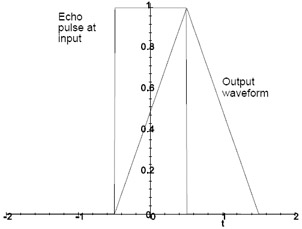
The optimum peak echo signal-to-mean-noise power is obtained using a matched filter. In the case of echoes from moving scatterers, the filter must be matched for the Doppler frequency shifts of the echo signals. For a rectangular pulse with a sin x/x spectrum, the matched filter must have a sin x/x characteristic. If the filter is fully matched with a sin x/x bandpass characteristic, the output of the filter has a (sin x/x) 2 spectrum which is the spectrum of the delayed triangular pulse shown in Figure 8.1.


Figure 8.1: The input waveform of a filter fully matched to a rectangular pulse compared to the output waveform.

The output waveform too has the same width at the 50% points on the voltage plot but no overshoots. Commonly, a filter with a simple rectangular or Gaussian shape is used. Such a filter is called a matching filter.

Mostly the filters are designed to match the initial "ideal" pulse generated in the transmitter before amplification and it must be remembered that this pulse is influenced on its...

UNLIMITED FREE
ACCESS
TO THE WORLD'S BEST IDEAS

SUBMIT
Already a GlobalSpec user? Log in.

This is embarrasing...

An error occurred while processing the form. Please try again in a few minutes.

Customize Your GlobalSpec Experience

Category: RF Filters and Microwave Filters
Finish!
Privacy Policy

This is embarrasing...

An error occurred while processing the form. Please try again in a few minutes.