Modern Radar Systems, Second Edition

The performance of a radar describes how far it can see (range), how accurately it can measure the position of an object (accuracy), how well it can resolve objects near to each other (resolution), and how well it can see objects against a background (clutter improvement). Managing the performance of a radar during development is a matter of punctilious control of budgets to achieve the specified end values. In this chapter, performance is divided into:
Range;
Accuracy;
Resolution;
Stability.
Each of these characteristics is the final result of a budget, that is best controlled by using a spreadsheet on a computer.
To cross the detection threshold in Chapter 12, the critical signal to background ratio, D s, must be exceeded. The background in clear conditions is always thermal noise, kT W/Hz, plus
Over ground clutter or in weather clutter (and chaff) the clutter signal or its residue (see Section 6.6);
Interference or jamming signals present in the receiver (see Section 14.6).
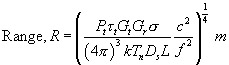
Range in clear conditions neglecting siting is determined by the range equation
| (14.1) | |
where the variables and their units are given in Table 14.1.
| Symbol | Parameter | Units | From Chapter |
|---|---|---|---|
| P t | Transmitter peak power | W | 3 |
| ? t | Transmitter pulse width, s | s | 3 |
| G t | Gain of the antenna for transmission | 5 | |
| G r | Gain of the antenna for reception | 5 | |
| ? | Scatterer cross section | m 2 | 6 |
| F | Propagation factor |