Modern Radar Systems, Second Edition

This chapter covers what happens to the transmitted pulse after it leaves the antenna and travels through the atmosphere until part of it is scattered back to the radar. The echo signal that enters the receiver is often not an exact copy of the transmitted pulse because the scatterer may have radial components of movement that shift the frequency of the echoes. The limited time taken to look at the objects of interest broadens the spectrum of the echo signals that are passed by the antenna to the receiver.
This chapter describes the amplitude and the phase of the returning echoes with the phenomena encountered by the signals on their way out and back. This chapter discusses the following:
Effects of the atmosphere, refraction, and attenuation;
Scattering at objects with fluctuation characteristics;
Ground reflections;
Typical scenario for a model radar;
A number of examples of range-height paper in Appendix 6A.
The pulse that leaves the antenna spreads out in space, is scattered by the objects it hits, and part of the scattered energy is directed toward the receiving antenna of the radar.
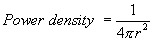
The power radiated from an isotropic radiator is spread over the inside of a sphere of radius r. The area of the surface of the sphere is 4 ? r 2, so that the power density is inversely proportional to the square of the distance (inverse square law).
| (6.1) | |
Radars detect the echoes...