Photodetection and Measurement: Maximizing Performance in Optical Systems
3.2: Shot Noise

3.2 Shot Noise

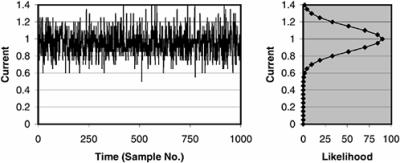
Shot noise is the uncertainty in determining the magnitude of a current. It might be thought to be present in any current, whether generated by photodetection or delivered by the wall-socket wiring, although not necessarily with the same relative magnitude. In practice it appears to be relevant only in junctions where there is a "barrier" that carriers must cross, and this includes photocurrents generated in photodiodes. The term shot noise arose on listening to the fluctuations in current in vacuum diodes run in their "temperature-limited" region with headphones. Current variations sound like lead shot raining down on a metal plate. If a large number of precision measurements is made of a nominally constant current and the results are plotted, the results should be distributed evenly around the nominal value as shown in Fig. 3.1. On the right of the figure is a histogram that shows the likelihood of measuring a current in a given current "bin." Clearly the most frequently encountered measured value is the nominal current, here I mean = 1.0, but there will always be some fuzziness.


Figure 3.1: Multiple measurements of a photocurrent should provide a Gaussian (actually Poisson) histogram, with a variance equal to its mean.

A constant photocurrent ( I p) exhibits a current noise power spectral density given by:


where q is the charge on the electron (1.602 10 ?19C) and B is the measurement bandwidth in hertz. This is called the Schottky formula.

UNLIMITED FREE
ACCESS
TO THE WORLD'S BEST IDEAS

SUBMIT
Already a GlobalSpec user? Log in.

This is embarrasing...

An error occurred while processing the form. Please try again in a few minutes.

Customize Your GlobalSpec Experience

Category: Photodiodes
Finish!
Privacy Policy

This is embarrasing...

An error occurred while processing the form. Please try again in a few minutes.