Photodetection and Measurement: Maximizing Performance in Optical Systems
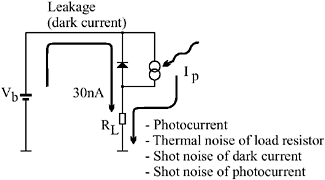
It is useful to estimate the detection noise and performance of the simple bias box system described in Chap. 2. We will assume that we are using a BPW34 silicon diode (a long-available plastic encapsulated device with an area of 7.6mm 2) operated with either 1k ? or 1M ? resistors at a 9V reverse bias (Fig. 3.3). The noise sources to be considered are the thermal noise of the resistive load, the shot noise of the leakage current, and the shot noise of the signal photocurrent. First consider the load resistance R L = 1M ? exhibiting its thermal noise voltage density of ![]()
Even in total darkness, reverse bias provided by the battery voltage V b = 9V drives reverse leakage current through the diode. The dark current specified for this diode at 9V reverse bias is 30 nA in worst case, leading to a DC offset on the resistor (30mV). It also gives a shot noise current density equal
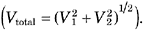
In the 20 MHz bandwidth of the oscilloscope this becomes 440pA rms. Flowing through the 1M ? load resistor, this leads to an additional noise voltage of 0.44mV rms, or about 2.6mV pk-pk. Note that uncorrelated noise contributions must be added as sums of squares
Table 3.3 summarizes the results, for 1K ? and 1M ? loads.