Photodetection and Measurement: Maximizing Performance in Optical Systems
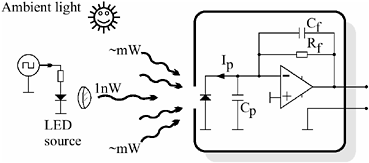
Apart from some optical fiber communications links, most optical detection systems do not enjoy the luxury of illumination just by the signal of interest; when the source is off, the detector is dark. The great majority are bathed in a background of ambient light from other sources (Fig. 7.1). The signal of interest may even be far weaker than the disturbing light. Clearly we need drastic measures to beat this level of adversary. Mechanical optical screening of either the photodetector, the complete apparatus, or the lab windows with shields and opaque curtains is an effective solution to stop light from entering, but much apparatus under development is operated in an open state. It is very difficult and even dangerous to debug optoelectronics in total darkness, so a compromise has to be reached. In addition, some optical systems such as TV remote controls, bar code readers, light-barriers, free-space communications links, and environmental monitoring systems are required to be open to ambient light.
At the very least we need systems that are unaffected by fairly constant light sources such as overcast skies and by the slow variations caused by moving clouds and people. Suppression of the main 100/120Hz signals from incandescent and fluorescent lighting is also mandatory. To combat these problems we have emphasized the great benefits of operating our optical systems...