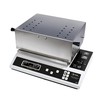
Weighing designs look at how to optimally combine small objects whose weights are to be determined into larger collections placed simultaneously onto a beam- or spring-balance. With an analytical treatment of the summed measurements, the individual weights can be estimated with smaller relative errors. The techniques are equally applicable to measuring a collection of summed low intensities, whose magnitudes can be estimated with improved signal-to-noise ratio. This treatment is taken directly from Harwit and Sloane (1979).
Suppose we need to weigh four objects, with true but unknown weights ? 1, ? 2, ? 3, ? 4, with a beam-balance that shows a significant error e. The balance has been calibrated as well as possible, such that the average error is zero, and a large number of repeated measurements will actually deliver the object s true weight. If we weigh each object separately, we obtain four readings ? 1, ? 2, ? 3, ? 4, and four errors e 1, e 2, e 3, e 4. The readings must be taken as the best estimate of the true weights. The expectation value of the errors themselves is zero ( E{ e} = 0), while the expectation value of the squares of the errors ( E{ e 2}), is just ? 2, the variance of the measurements, or the mean square error in the weight estimates.
Now suppose that instead we weigh groupings of objects...
Copyright The McGraw-Hill Companies, Inc. 2003 under license agreement with Books24x7


 TABLE OF CONTENTS