Photodetection and Measurement: Maximizing Performance in Optical Systems
This book has been concerned primarily with the analog domain of continuous-time detectors, opamps and RC networks. We have used it to design receivers, calculate their sensitivity, noise, bandwidth, rise time and so on. In the majority of cases, system performance will be defined by the analog domain characteristics of the early electronic stages. Nevertheless, at some point you will probably want to digitize your signals, and perhaps log a large number of measurements for analysis and reporting. It is often more convenient for this to perform some signal processing tasks in the digital domain, even if only averaging to reduce noise. There are many excellent books available on real digital signal processing (DSP). Here we touch on the absolute minimum requirements to survive in an increasingly digital world.
Whenever we digitize an analog value, whether using a networked high-speed analog-to-digital converter and data logger or by writing down the value shown on our digital or analog voltmeter, we are entering the domain of sampled data systems. The central problem of sampling is contained in Nyquist s theorem, which states that a continuous function can be perfectly reproduced from a set of sampled values, as long as the process captures at least two samples of the highest frequency component in the signal. Alternatively, this says that if we don t sample fast enough, we will see signals that are not really there. This is the problem of aliasing.
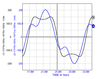
For a simple, concrete example, Fig. C.1 shows...