Photodetection and Measurement: Maximizing Performance in Optical Systems
3.3: Photon Statistics

3.3 Photon Statistics

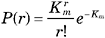
An alternative description of shot noise in photodetection can be obtained from analysis of photon statistics. When a constant intensity, perfectly monochromatic and perfectly polarized laser source is incident on a photodetector, the actual instant of generation of individual photoelectrons is a stochastic process. For a power of P s watts, the mean number of photoevents detected per second is P s/ h ? = K m, where v = c/ ? is the optical frequency, ? is the wavelength, and c is the velocity of light in vacuum. The probability P( r) of measuring r photoevents per second is given by:


This is the Poisson distribution, which has a variance equal to its mean K m. The standard deviation is However, for situations where the mean detection rate K m of photoelectrons is large, the Poisson distribution becomes identical to the Gaussian distribution. This is why in practice noise current appears to be distributed as a Gaussian function about the mean current, as in Fig. 3.1.

To obtain the full variation in photoevents detected per unit time, the above Poisson distribution for photodetection needs to be multiplied by the stochastic distribution of the incident radiation photons. This depends on whether the incident optical field is highly coherent, like that from a well-controlled laser, or is thermal radiation such as from a hot filament, gas discharge tube, or LED. These complex issues are...

UNLIMITED FREE
ACCESS
TO THE WORLD'S BEST IDEAS

SUBMIT
Already a GlobalSpec user? Log in.

This is embarrasing...

An error occurred while processing the form. Please try again in a few minutes.

Customize Your GlobalSpec Experience

Category: Wavefront Sensors
Finish!
Privacy Policy

This is embarrasing...

An error occurred while processing the form. Please try again in a few minutes.