Photodetection and Measurement: Maximizing Performance in Optical Systems
The majority of photoreceiver designs fall into a couple of simple configurations, usually a reverse-biased photodiode with voltage follower or transimpedance amplifier and resistive load. However, these are not the only ways to detect light and design receivers, and we should be open to alternative approaches. In this section we look at a handful of less common but occasionally very useful photodetection configurations.
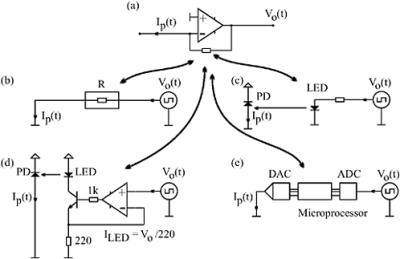
We have pointed out the considerable difficulty of choosing the transimpedance feedback resistor in some applications. Perhaps the high values required are not available, they are too expensive, their temperature coefficients are too large, they show excessively high parasitic capacitance, or they are physically too large for the application. This begs the question: what is a resistor? We could be pedantic and say that it is a two-port linear network for converting a time-varying voltage into a proportional time-varying current! There are many other ways to perform this function. Figure 4.1a shows a transimpedance configuration drawn upside down, with its two-port linear network underneath. Rather than considering the output voltage as the result of the photocurrent, here we say that it is the voltage V o( t) that drives the photocurrent I p( t) through the transimpedance network and photodiode. Below the transimpedance are four circuit fragments that perform the same function.
Figure 4.1b is just the transimpedance itself. Figure 4.1c uses the...