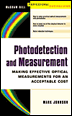
Photodetection and Measurement: Maximizing Performance in Optical Systems
Resistor/capacitor and to a lesser degree resistor/capacitor/inductor networks form the basis of a huge variety of common laboratory electronic circuit techniques, including quiet and stabilized power supplies, noise filters, AC-coupling, differentiators, sample-and-holds and transmission lines. They also provide good models to calculate much of the behaviour of photodetection systems, from the simplest resistively-loaded photodiode to the most complex filtered transimpedance amplifier. We have seen that system optimization is a complex matter, with strong interactions between noise and bandwidth performance depending on the choice of the active elements and passive components used. This all suggests that we will not get far without convenient techniques to reliable calculate their performance over the frequency range of interest.
The choice of tools for this job is large, ranging from elaborate electronic simulation ("Spice") software, which gives the results without much feel for what is important, to rigorous analysis with pencil and paper, which is big on feel, but too tedious for all but the simplest circuits. Spreadsheets, general mathematical programming languages and symbolic software hold the middle ground. At different times it is useful to have all these tools available, with the convenience of one balanced against the fancy graphics of the other. Whichever package you use there is always something you wish it would handle better. What is probably much more telling than the choice of analysis tool, however, is one's fluency with it. It is often better to be an expert user of an outdated package than to stumble along...