Photodetection and Measurement: Maximizing Performance in Optical Systems
Up to now we have considered only static noise sources and modification by the connected amplifier. However, as we have seen, feedback resistors exhibit stray capacitance, photodiodes have parasitic capacitance, and amplifiers have input capacitance and frequency-dependent gain characteristics, all of which combine to modify the overall noise as a function of frequency. In this section we address the main features which can significantly affect dynamic system performance. We will restrict the discussion to circuits with opamps, but the principles are equally applicable to any amplifier design. The approach is simply to apply wellknown feedback amplifier gain expressions, including all the significant frequency-dependent components.
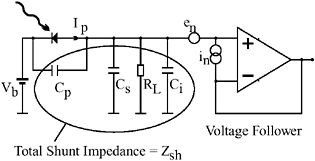
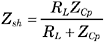
The follower configuration of Fig. 3.8 is straightforward, as the load seen by the photodiode current generator is the parallel combination of the load resistor R L, its parasitic capacitance C s, the input capacitance of the amplifier C i, and the parasitic capacitance of the photodiode C p. In most cases C s will be negligible in comparison with the others. We will lump all the contributions in with C p. Writing for the total frequency-dependent impedance:
Z Cp = 1/ sC p is the impedance of the total parasitic capacitance, and s = j2 ?f