Photodetection and Measurement: Maximizing Performance in Optical Systems
In earlier chapters we investigated techniques for optimizing the detection sensitivity of weak optical signals and for achieving high repeatability of measurements of relatively strong signals. The primary technical difficulties addressed were, respectively, noise and stability, which we treated as operating independently. Here we will look at an important measurement situation where the two errors are strongly coupled. This concerns the performance of an instrument in detecting very small variations in its measurand, that is, the instrumental characteristic of limit-of-detection or LOD.
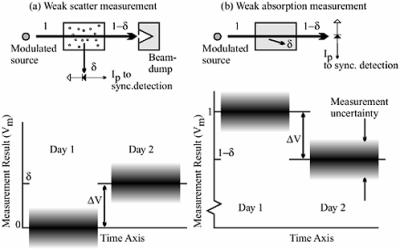
Consider first the design of a high-sensitivity on-line scattered light measurement system, such as a turbidimeter used for analysis of drinking water (Fig. 10.1a). A high-power modulated light source is projected through the sample to a beam dump, while a high sensitivity receiver collects the scattered light, synchronously detects the source modulation, and displays the turbidity reading V m. During commissioning the water is independently verified to be particle-free, so the relative light scattering efficiency ? and photocurrent I p should be almost zero. As the signal is so weak, repeated readings of the instrument s display V m are made and shown to be distributed around zero, as expected. This is represented by the fuzziness of the measurement result at the calibration shown as Day 1.