Process Control: A First Course with MATLAB

Written from the perspective of a student, this text emphasizes the importance of computers in the modern age of teaching and practicing process control.
 TABLE OF CONTENTS
 First an impetus is provided for solving differential eq uations in an approach unique to control analysis. The mass balance of a well-mixed tank can be written (see Review Problems) as

where C is the concentration of a component, C in is the inlet concentration, C 0 is the initial concentration, and ? is the space time. In classical control problems, we invariably rearrange the equation as
| (2.1) | 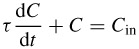 |
and further redefine variables C' = C - C 0 and  = C in - C 0. [1] We designate C' and
  as deviation variables - they denote how a quantity deviates from the original value at t = 0. [2] Because C 0 is a constant, we can rewrite Eq. (2.1) as
| (2.2) |  |
Note that the equation now has a zero initial condition. For reference, the solution to Eq. (2.2) is [3]
| (2.3) | 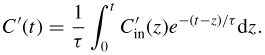 |
If  is zero, we have the trivial solution C' = 0. It is obvious from Eq. (2.2) immediately. For a more interesting situation in which C' is nonzero or for C to deviate from the initial C 0,
  must be nonzero, or in other words, C in is different from C 0. In the terminology of differential equations, the right-hand side (RHS)
  is called the forcing function. In control, it is called the input. Not only is