Process Control: A First Course with MATLAB

Written from the perspective of a student, this text emphasizes the importance of computers in the modern age of teaching and practicing process control.
 TABLE OF CONTENTS
 Now that we can do Laplace transform, let us return to our first example. The Laplace transform of Eq. (2.2) with its zero initial condition is ( ?s + 1) C'( s) =  ( s), which we rewrite as
| (2.27) | 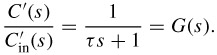 |
We define the RHS as G( s), our ubiquitous transfer function. It relates an input to the output of a model. Recall that we use deviation variables. The input is the change in the inlet concentration,  ( t). The output, or response, is the resulting change in the tank concentration, C'( t).
What is the time domain response C'( t) in Eq. (2.27) if the change in inlet concentration is (1) a unit-step function and (2) an impulse function?
With a unit-step input,  ( t) = u( t) and
  ( s) = 1/ s. Substitution for
  ( s) in Eq. (2.27) leads to

After an inverse transform by means of a look-up table, we have C'( t) = 1 - e -t/?. The change in tank concentration eventually will be identical to the unit-step change in inlet concentration.
With an impulse input,  ( s) = 1, and substitution for
  ( s) in Eq. (2.27) leads to simply
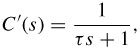
and the time-domain solution is C'( t) =  e -t/?. The effect of the...