Radar Cross Section Measurements
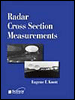
Presenting and explaining the rules of good measurement practice, this valuable reference explains how RCS is typically measured on test ranges, and how testing may be tailored to meet specific requirements.
 TABLE OF CONTENTS
 The radar cross section of an object exposed to a radar is a fictitious area that describes the intensity of the wave reflected back to the radar. The RCS, as it is known in the trade, can be stated in very simple terms: it is the projected area of an electrically large, perfectly conducting sphere whose echo strength would match that of the target if we were to replace the target with the sphere. By electrically large we mean a sphere at least several wavelengths in diameter, and the projected area is simply ? a 2, where a is the radius of the sphere. The metal sphere is entirely fictitious, but does convey to most people a mental concept of an equivalent physical size for a radar target.
As we shall show later in this book, the echoes of most targets vary considerably with changing aspect angle and radar frequency, whereas the echo of a large sphere scarcely changes at all. To accommodate the actual variation in the echo strengths of objects in the beam of a radar, we would have to imagine that our equivalent metal sphere could expand and contract in size with changing aspect and frequency. Thus, although the notion of an equivalent sphere is useful, it can also be clumsy. Our best recourse is probably to simply regard the radar cross section of an object as a measure of the intensity of the radar...