Radar Cross Section Measurements
Presenting and explaining the rules of good measurement practice, this valuable reference explains how RCS is typically measured on test ranges, and how testing may be tailored to meet specific requirements.
 TABLE OF CONTENTS
 The history of the development and operation of dynamic test ranges probably antedates the installation of static test ranges, but we do not catalog them here. Instead, we describe a few new and not-so-new installations, some ground-based and some shipborne, and we even include a brief description of plans for a new, state-of-the-art system intended for the White Sands Missile Range in New Mexico. We begin with the Advanced Range Instrumentation Ships (ARIS).
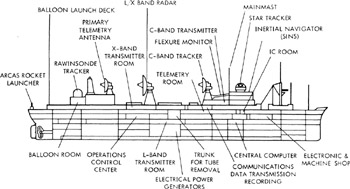
The U.S. Department of Defense fitted several ships with radar instrumentation in the 1950s for a variety of reentry-vehicle test missions, ranging from trajectory measurements to decoy studies to studies of reentry physics. The largest and most expensive of these were a pair of refurbished World War II troop carriers, each equipped with no fewer than three radars. The ships were the H. H. Arnold and the H. S. Vandenburg, whose namesakes were two distinguished U.S. Army Air Force General Officers. The ships were originally configured as shown in fig. 11.24.
Although ostensibly assigned to the U.S. Air Force Western Test Range for the support of tests of long-range U.S. missiles,...