Radar Cross Section Measurements
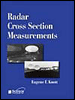
Presenting and explaining the rules of good measurement practice, this valuable reference explains how RCS is typically measured on test ranges, and how testing may be tailored to meet specific requirements.
 TABLE OF CONTENTS
 Three motives demand that extraordinary measures sometimes be taken to protect the physical integrity of the target and the scattering data collected from it. These are:
To satisfy Department of Defense requirements
To improve range efficiency
To protect the target and test data from industrial espionage
They are listed in the order of their importance, and the measures taken to ensure the first are generally more than adequate to ensure the second and third. As we discuss the various procedures implemented on most test ranges to enhance test security, we will see how important the first has become.
We briefly discuss the three incentives in reverse order. It is well known that dozens of companies employ industrial spies in order to gain competitive advantages over other companies marketing the same kinds of products. The automotive and fashion industries are infamous for such activity. Spies may be individuals employed to infiltrate the staff of competitors as employees, but they may also be outside people adept at forming acquaintances with the employees of competing companies, and equally adept at subtly extracting information from them. Sometimes the information is obtained by extortion, but simple eavesdropping can be nearly as effective. Not surprisingly, the methods used in industrial espionage are much the same as those used by governments that spy on one another.
As attested by the lack of an "RCS Measurements" category in the Yellow Pages, there is no public market for either RCS design or RCS testing. As...