Radar Cross Section Measurements
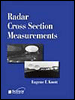
Presenting and explaining the rules of good measurement practice, this valuable reference explains how RCS is typically measured on test ranges, and how testing may be tailored to meet specific requirements.
 TABLE OF CONTENTS
 While test targets may be installed on support pylons or foam columns and rotated in the beam of an instrumentation radar for static measurements, the data collected do not necessarily indicate the signals that would be sensed by an operational radar tracking a tactical target. This is because engine turbines rotate, the stresses of flight vibrate an airframe, and the motion of the wheels and tracks of ground vehicles constantly changes the target configuration from one instant to the next. Moreover, the target support structures used on static test ranges are capable of supporting a few thousand pounds at best, while some tactical targets weigh dozens of tons or, in the case of the B-l and B-2 bombers, hundreds of tons. Further, some tactical ground targets, like trucks and tanks, should probably be measured on the ground, rather than being awkwardly isolated from the ground environment on a support tower, even if one were to be built. Thus, measurements performed on a static range often must be validated or checked on dynamic test ranges, for which the measurement problem is much more challenging.
The instrumentation radar must be equipped with a tracking system so that it may follow the target automatically. That system may be a separate radar that performs only the tracking function, or it may be built into the instrumentation radar itself. Because the substitution method of calibration may not be feasible, all the influential parameters entering the radar range equation must be carefully measured before a...