Radar Cross Section Measurements
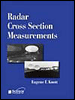
Presenting and explaining the rules of good measurement practice, this valuable reference explains how RCS is typically measured on test ranges, and how testing may be tailored to meet specific requirements.
 TABLE OF CONTENTS
 Given the measurement of the RCS characteristics of a target on a static test range over a reasonably wide range of aspect-angle and elevation-angle variations, static test-range data can be used to estimate the signals that would be received by most tactical sensors. It requires a reasonably faithful model of the tactical scenario to do so, however, and since there are not many of them, and since it requires a great deal of ingenuity to adequately simulate the dynamic motion of a tactical target, many of the models are suspect. Airfoils flex, turbines and propellers spin, and airborne and marine targets alike are buffeted by the ambient environment. Moreover, many targets are simply too big to install on a static test range for conventional RCS measurements. It is therefore very easy to justify the need for, if not the cost of, dynamic RCS test facilities.
Two kinds of radars are typically employed on the dynamic test range, one an instrumentation radar and the other a tracking radar. In some cases a single radar can perform both missions, and although the tracking function can be performed optically in some installations, optical tracking generally yields only angular position information. Thus, the range to the target must typically be derived from other range instrumentation systems, such as a radar tracker, or even from gyro position and attitude sensors installed aboard the target itself. Because the range to the target varies in all dynamic RCS testing, and because its effect must be...