Radar Cross Section Measurements
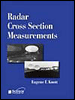
Presenting and explaining the rules of good measurement practice, this valuable reference explains how RCS is typically measured on test ranges, and how testing may be tailored to meet specific requirements.
 TABLE OF CONTENTS
 Most test objects are large enough in terms of wavelengths that their RCS patterns are often characterized by 20- to 40-dB fluctuations between peaks and nulls that are sometimes separated by barely a fraction of a degree. While this detail can be absorbed and interpreted by a skilled analyst working with a few patterns, it can be overwhelming when several dozen such patterns must be compared and analyzed, relative RCS values extracted, and conclusions drawn about their implications. For comparison purposes, therefore, the analyst often relies on smoothed data from which the rapid fluctuations have been filtered by statistical processing.
That processing may include the extraction of statistical measures, such as the mean, median, standard deviation, and higher-order moments, but there remains a controversy whether the processing should be performed in "dB space" or in "linear space." That is to say, the users of processed RCS data have yet to agree on the meaning of the statistical measures they order. The controversy is due, in part, to a failure to adequately identify the purpose of the measurements: if the purpose of testing is known, the required processing should be apparent. Much of the controversy is due, therefore, to a failure to identify why the measurements were undertaken in the first place.
Whether processed or not, there are two formats for presenting the information: the common rectangular plot and the less familiar polar plot. (The format for radar imagery, which is neither of these, is discussed in Chapter 10.) The...