Radar Cross Section Measurements
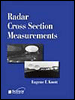
Presenting and explaining the rules of good measurement practice, this valuable reference explains how RCS is typically measured on test ranges, and how testing may be tailored to meet specific requirements.
 TABLE OF CONTENTS
 There are two kinds of calibration required in RCS measurements, one involving the instrumentation system and the other accounting for the electromagnetic environment in which the target is immersed. The availability of microprocessors and frequency synthesizers has made it possible to perform both kinds of calibration continuously.
The well-design noncoherent instrumentation radar outputs a signal very nearly proportional to the logarithm of the received signal. This linearity can be assumed only over limited dynamic range, however. At the upper end (strongest received signals) the receiver saturates, and at the lower end noise contaminates the received signal. We can compensate for these nonlinearities by measuring the receiver transfer function and using that function to convert the receiver output signal to a reasonably accurate representation of the receiver input signal. This is one kind of calibration.
The other kind of calibration involves the radar range equation. Although we can measure the individual parameters appearing in that well-known expression, and thereby calculate the constant of proportionality between the received power and the RCS, a different calibration is almost always used when test objects are measured on static RCS ranges. Except for the RCS, all other parameters in the radar range equation are fixed by the instrumentation system and the geometry of the test range. The combined effect of those parameters may be established (calibrated), therefore, by the replacement of the target (whose RCS is unkown, lest we would not be measuring it) with one whose RCS is known with a high degree...